
Cash Crypto and FreedomSwitzerland Just Protected Cash in Its Constitution — A Warning for the Cashless FutureCash Crypto and Freedom
The Swiss vote reveals something important about the future of money: cash, crypto, and digital payment rails may all coexist.
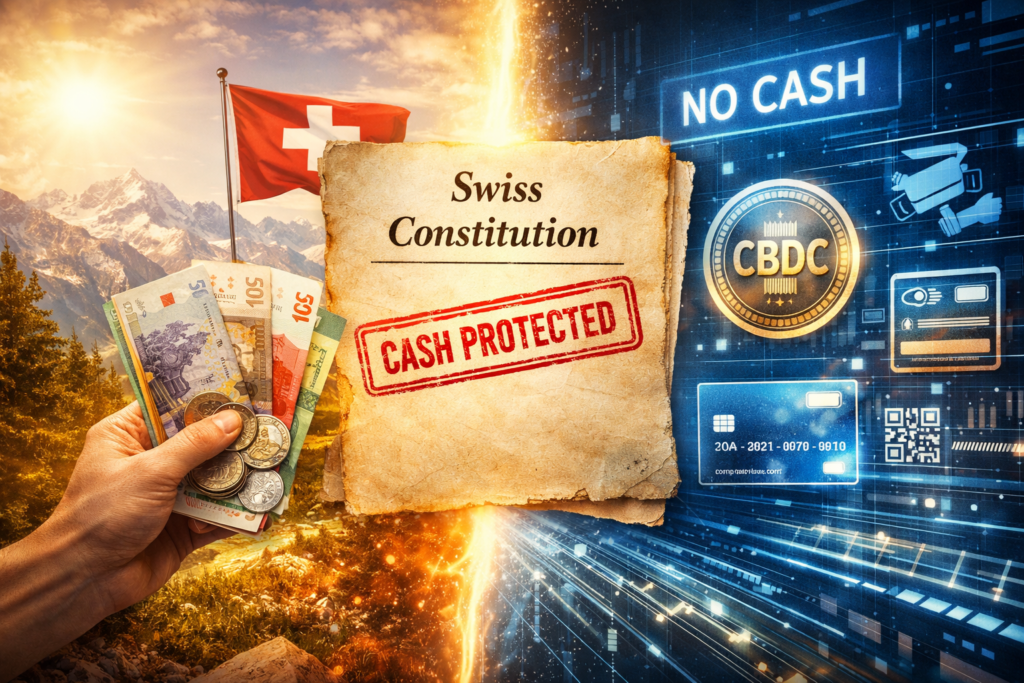
In March 2026 Switzerland took a rare step in modern finance. While many governments are moving toward cashless systems and digital currencies, Swiss voters approved a constitutional amendment guaranteeing that physical cash must remain available. The decision highlights a growing global debate about cash, crypto, and freedom—an issue that now intersects directly with Bitcoin, stablecoins, and the emerging digital payment infrastructure.
Switzerland Protects Freedom by Protecting Cash
This month Switzerland approved a constitutional amendment designed to protect cash—something many countries have been trying to move away from. While much of the world is moving toward digital payments and central bank digital currencies, Swiss voters decided that banknotes and coins must remain available as a form of money.
The move reflects a deeper principle about money, freedom, and monetary choice—a principle that has become more visible in recent years with the invention of Bitcoin and blockchain technology.
Switzerland is not rejecting digital payments. In fact, it is one of the most advanced financial systems in the world, where cards, bank transfers, and mobile payments are widely used. What the Swiss are protecting is something more fundamental: the freedom to choose how money is used.
Why Protect Cash
Many Swiss citizens worry, like many people across the free world, that a fully digital financial system could introduce serious risks.
Among the concerns frequently mentioned are:
• Loss of financial privacy
• Dependence on banks and digital infrastructure
• Vulnerability during cyberattacks or power outages
• Greater government control over financial activity
In this context, cash represents a form of financial sovereignty. It is money that works without permission, without electricity, and without intermediaries.
In times of emergencies or crises, there is nothing more reliable than having cash in hand.
The Connection to Bitcoin and Blockchain
Bitcoin was designed mainly for two reasons. The first was to create a permissionless form of money. Bitcoin is a global monetary network that requires no permission to transact. No matter where you are in the world, and no matter what time it is, value can be transferred freely between two parties—provided they have internet access. The second objective was to create hard money that cannot be inflated, deflated, or manipulated by a central authority.
Cash does not fully share this second characteristic because it exists within a central banking fiat system where money can be expanded or contracted through monetary policy. However, cash still retains an important feature of monetary freedom: it does not require permission to trade. Like Bitcoin, cash is a network that anyone can use freely and privately.
Cash and Cross-Border Freedom
Cash also moves freely across borders. For countries suffering from unstable monetary systems, access to physical currency from stronger economies can provide an important alternative. For example, in parts of Latin America, people frequently use U.S. dollars or other foreign currencies when their domestic currency is under pressure. Bolivia today uses both dollars and Peruvian soles in many transactions because its own currency is under stress. Cash gives citizens in these situations a form of monetary choice that protects them from irresponsible monetary policy.
Moreover, today, stablecoins such as USDT are increasingly used for cross-border payments, allowing businesses and individuals to move value globally in minutes without relying on the slow and expensive traditional banking system.
Cash and Inflation
Cash can even influence inflation dynamics. In places where governments try to eliminate or restrict physical currency, people often lose trust in the financial system. Venezuela provides a clear example. There have been periods when prices in physical Bolívar notes were lower than prices paid through digital bank balances, reflecting the population’s distrust of the digital system. Every time the Venezuelan government tried to remove large amounts of cash from circulation, inflationary pressures worsened and authorities eventually had to release more banknotes into the system. In this sense, cash can act as a stabilizing force in a monetary system because it provides people with an alternative outside purely digital control.
Peru and the Rise of Crypto Payments
These global trends are also visible in Peru. As international commerce becomes more digital, many businesses and individuals are beginning to use stablecoins like USDT for cross-border payments and faster access to dollars. In cities like Lima, the demand for reliable crypto exchange services and USDT transactions has grown steadily as people look for alternatives to slow international bank transfers. The combination of traditional cash, digital banking, and crypto infrastructure is gradually creating a more flexible financial system across the region.
Conclusion
Switzerland’s decision to protect cash is about protecting choice. Cash preserves financial freedom in the physical world, while Bitcoin and blockchain extend that freedom into the digital world. As global commerce increasingly moves online and across borders, stablecoins and crypto networks are emerging as the payment rails of the internet economy. The future of money will likely include all three—cash, crypto, and digital infrastructure—working together to give people greater control over how they store and exchange value. Switzerland’s decision highlights the growing relationship between cash, crypto, and freedom in the modern financial system.