
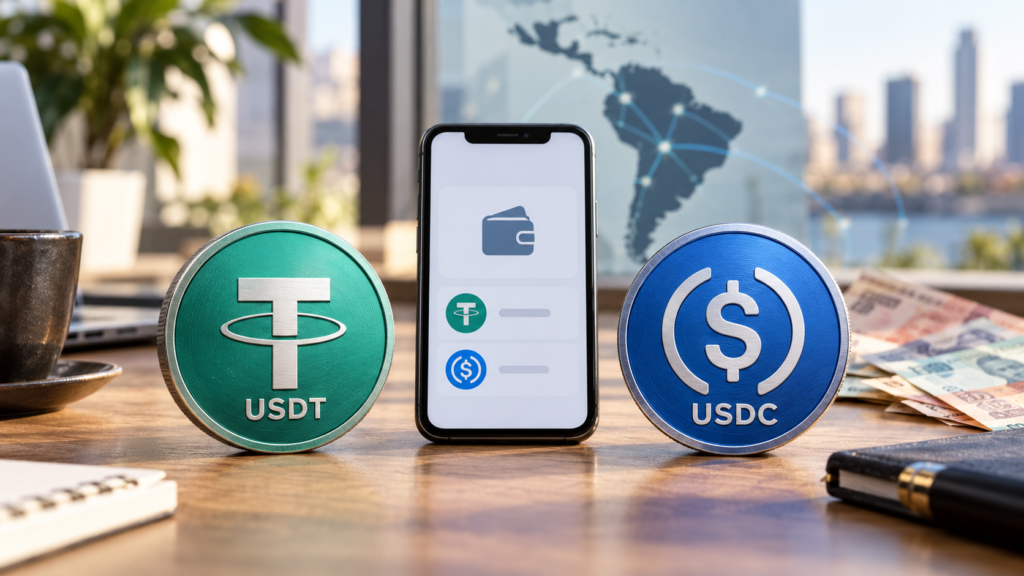
USDT vs USDC in Latin America: What Matters to Users?
When people compare USDT vs USDC in Latin America, the useful question is not which token wins on a global chart. It is which one their exchange, supplier, or local money house will accept—and what they will receive when they convert it to pesos, soles, reais, or another local currency. Liquidity, supported networks, and the final cash-out rate matter more in everyday use than a stablecoin’s ticker alone.
USDT vs USDC in Latin America: what the market data says
USDT and USDC are both designed to track the U.S. dollar, but they do not have the same market footprint. Reuters reported in October 2026 that Tether’s USDT held about 60% of the global stablecoin market, compared with roughly 25% for Circle’s USDC. That global difference can help USDT show up more often across exchanges and trading pairs, but it does not prove that USDT is more liquid at every local exchange counter in Latin America.
Regional conditions matter. Chainalysis estimates that Latin America received about $593.8 billion in crypto value from July 2025 through June 2026. Its analysis describes growing stablecoin use across the region, with different patterns by country. That total covers crypto activity overall; it is not a measure of USDT or USDC use alone. A buyer in Argentina, Brazil, Colombia, Peru, or Venezuela still needs to check what local platforms actually quote and settle.
USDT liquidity and local availability: check the off-ramp
A token can have a large global market and still be inconvenient in a particular city. Before choosing, check whether your exchange lists the token you need, whether the person or business receiving it accepts it, and whether a local provider will buy it back for cash or bank transfer.
Compare the amount you will actually receive after the spread, transfer fee, and any payout charge. If you are selling USDT or USDC for local currency, ask for the final quote in the currency you want. A small difference in the quoted price can outweigh a token’s theoretical advantages.
USDT may be the practical choice when a supplier, exchange, or money house quotes it more consistently. USDC may be just as practical—or better—where a platform has deeper USDC markets or a business specifically requests it. Treat local liquidity as a question to verify, not an assumption based on global market share.
For more on how stablecoins can support cross-border settlement, see our article on USDT cross-border settlement. For current buying and selling information, visit EWFOREX.
USDT and USDC redemption: direct issuer or local sale?
“Redeemable for one U.S. dollar” describes the issuer’s redemption terms. It does not mean every individual can exchange a token directly with its issuer and receive dollars in a local bank account.
Circle says Circle Mint is available to institutions, not individuals. It supports bank transfers in many countries, but eligibility and service depend on the customer and jurisdiction. Tether’s direct redemption process has a minimum of $100,000 and a fee of the greater of $1,000 or 0.1%, according to its current fee schedule. These issuer routes are not the usual cash-out option for a retail user with a few hundred or a few thousand dollars in tokens.
Most individual users rely on an exchange, broker, payment service, or money house to convert stablecoins. That is why the availability, price, limits, and payout method at the local off-ramp are central to the USDT vs USDC decision in Latin America.
Supported networks can change the answer
USDT and USDC operate across multiple blockchain networks, and their supported networks do not always match. The receiving platform may accept one token on Ethereum but not on another chain; a token bridged from elsewhere may also be treated differently from the issuer’s native version.
Before sending, confirm the exact token and network with the recipient. Check the network fee, expected settlement time, and whether the receiving service credits that deposit method. The sender and receiver must use the same supported network. A cheaper transfer is no help if the other side cannot receive it.
Check Tether’s current list of supported protocols and Circle’s USDC supported-blockchain information before transferring. These lists can change, so confirm directly with the exchange or wallet as well.
Transparency and issuer access
Both issuers publish reserve information, but in different formats and schedules. Circle says USDC reserve holdings are disclosed weekly and that a Big Four accounting firm provides monthly third-party assurance. Tether says it typically publishes circulation information daily and reserve information quarterly. These are issuer-published materials; readers should review the latest reports and understand what an assurance report does—and does not—establish.
Reserve reporting is one part of evaluating a stablecoin. It does not tell you whether your exchange is solvent, whether a local provider has cash available, or whether you can sell at exactly one U.S. dollar in a particular market. The March 2023 USDC depeg also showed that market prices can temporarily move away from the intended peg during stress, even when the issuer continues processing redemptions under its terms.
Circle’s planned expansion into new markets
There is also a timely development to watch. On October 16, Circle CEO Jeremy Allaire told Reuters that the company is pushing to enter about 40 emerging and developing markets. He pointed to organic demand in regions including Latin America, Africa, the Middle East, and Southeast Asia.
This is a planned expansion, not confirmation that Circle has launched a USDC cash-out service in 40 named countries. New partnerships could improve USDC access over time, but users should look for a live exchange listing, payment partner, and local payout route before assuming that access has changed in their market.
Which stablecoin should you choose?
| What you need | What to check |
|---|---|
| Pay a supplier or receive funds | Which token and network the other party accepts |
| Sell for local currency | The live final quote, payout method, limits, and fees |
| Move between exchanges | Supported networks and deposit/withdrawal rules on both platforms |
| Redeem directly with an issuer | Eligibility, country availability, minimum amount, and fees |
| Compare issuer information | The latest reserve disclosures and assurance reports |
The practical answer to USDT vs USDC in Latin America depends on the route you will use. If USDT has stronger local liquidity and a better quote for your transaction, it may be the convenient option. If your recipient or platform prefers USDC and gives you a reliable conversion route, USDC may fit better. Compare the whole transaction—from the wallet you send from to the local currency you receive—and confirm every detail before transferring.
In short: choose the stablecoin that your counterparty accepts, that works on the right network, and that you can convert locally at a clear price. Global market share is useful context, but your actual cash-out route is what determines whether the token works for you.
Sources
- Reuters: Circle plans to enter about 40 emerging and developing markets
- Chainalysis: Latin America’s 2026 crypto adoption
- Circle: USDC transparency and reserve reports
- Circle: USDC overview and supported blockchains
- Federal Reserve: USDC market stress during the March 2023 SVB crisis
- Tether: USDT fee schedule
- Tether: USDT transparency