
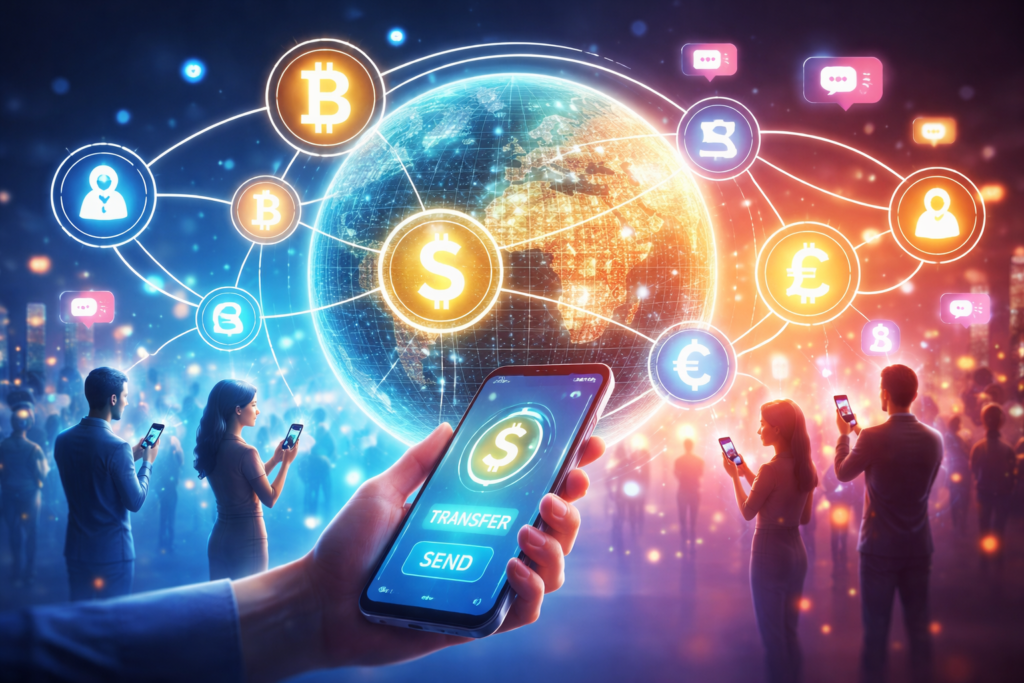
Why X Money Matters Even Though Global Peer-to-Peer Payments Already Exist
X is moving toward becoming more than a social media platform by building payment rails into its ecosystem through digital wallets, bank connections, debit-card functions, and peer-to-peer transfers. That is significant because once a platform with that kind of reach begins integrating payments, the path toward broader digital value transfer becomes much smaller. Global peer-to-peer payments already exist. People can already move value across borders through banks, fintech apps, crypto, and stablecoins. So the real story is not that X is inventing something new. The real story is that a platform with massive scale may help bring these existing capabilities further into the mainstream and speed up adoption by reducing friction for everyday users. That is what makes this important.
X Is Quietly Moving Toward Crypto-Style Transfers
X is not presenting this as a full crypto move, but it is clearly moving into payments. Once a platform connects users to wallets, bank accounts, debit cards, and peer-to-peer transfers, it has already built the foundation. At that point, adding crypto or stablecoins later is not a leap, it is just another layer on top.
This does not mean X will transform the financial system overnight. It means the platform is putting the infrastructure in place first. The rails come before the assets. Once those rails exist, different forms of value—fiat, stablecoins, or crypto—can move across them more easily.
That is why this matters. Not because peer-to-peer payments are new, but because a platform with massive reach is positioning itself to distribute them at scale.
How Global Peer-to-Peer Payments Already Work
Global peer-to-peer payments already exist. People are already moving value across borders every day through banks, fintech apps, crypto networks, and stablecoins.
Traditional banking systems allow international transfers, but they are often slow and expensive. Fintech platforms improved this by making transfers faster and more user-friendly. Crypto took it a step further by allowing value to move directly between users without relying on banks. Stablecoins then built on that by combining the speed of crypto with the price stability of fiat currencies.
So the capability is already here. The infrastructure for moving value globally, peer to peer, has already been built.
The limitation is not the system itself. It is how widely that system is used.
Most of these tools still exist outside of the platforms people use every day. They require separate apps, separate accounts, and a certain level of familiarity. That keeps adoption lower than it could be.
That is why the role of large platforms matters. They do not need to reinvent global peer-to-peer payments. They only need to bring them into an environment where people already are.
Global Peer-to-Peer Payments Already Exist
This is the part many people miss.
None of this changes the fact that global peer-to-peer payments already exist. People are already sending value internationally through crypto wallets, stablecoins, exchanges, remittance networks, and digital payment apps. In that sense, the world has already crossed the line. The capability is already here.
Bitcoin proved that value can move without banks. Stablecoins proved that dollar-linked value can move globally with speed and low friction. Payment apps proved that consumers will use digital transfers when the interface is simple enough. So the foundation has already been laid.
That is why the significance of X is not innovation in the pure sense. X is not inventing peer-to-peer finance. It is entering a field that already exists.
What a Platform Like X or Facebook Actually Changes
What a platform like X or Facebook brings is not the invention of the system, but the distribution of the system.
That is a major difference.
A global peer-to-peer payment network can exist for years and still remain limited in practical use, not because people reject it, but because most people are still unfamiliar with it. Crypto has largely existed on the fringe. Names like Bitcoin, Ethereum, Binance, Bitfinex, and Coinbase are well known within the space, but to the average person they are still relatively new and often associated with volatility and government scrutiny. That creates hesitation.
Most users do not adopt new financial tools simply because they exist. They adopt them when those tools feel familiar, trusted, and easy to use.
That is where a large social platform changes the equation.
When payments are built into a major platform, the act of moving value becomes more natural. It stops feeling like a separate financial activity and starts feeling like a native part of online interaction. Sending money becomes closer to sending a message, paying a creator, making a purchase, or settling an account with a contact already inside the same network.
That does not create a new financial reality. But it can expand participation dramatically.
This is the real importance of integration. It reduces friction. It lowers the mental barrier. It brings digital payments in front of users who would never go out of their way to learn crypto, open exchange accounts, or experiment with standalone wallets. In other words, it accelerates adoption not by changing the underlying system, but by making that system easier to enter—especially when that system is introduced through a platform people already know and trust, like X (formerly Twitter).
Why This Matters More Than the Rumors
A lot of people get distracted by rumors about which token might be used, whether XRP will be integrated, or whether some platform will create its own stablecoin. Those are interesting questions, but they are secondary.
The bigger issue is that once a large platform successfully connects attention, identity, messaging, and payments, it becomes much more than a media platform. It becomes a kind of digital commercial layer. At that point, adding new forms of settlement later becomes much easier.
That is why the payments move matters more than any single coin rumor. The rails matter more than the asset. Build the rails first, and many assets can later move across them.
Conclusion
X moving into payments does not mean the world suddenly has a new way to transfer value. That world already exists. People already move value globally peer to peer every day.
What makes this important is that a platform with massive scale can take an existing capability and push it into wider everyday use. That is the real story. Not invention, but expansion. Not a new financial reality, but a faster path toward mainstream adoption.
That is why a large platform integrating payment wallets matters. It does not change the essence of global peer-to-peer payments. It changes how quickly and how widely people begin to use them.