
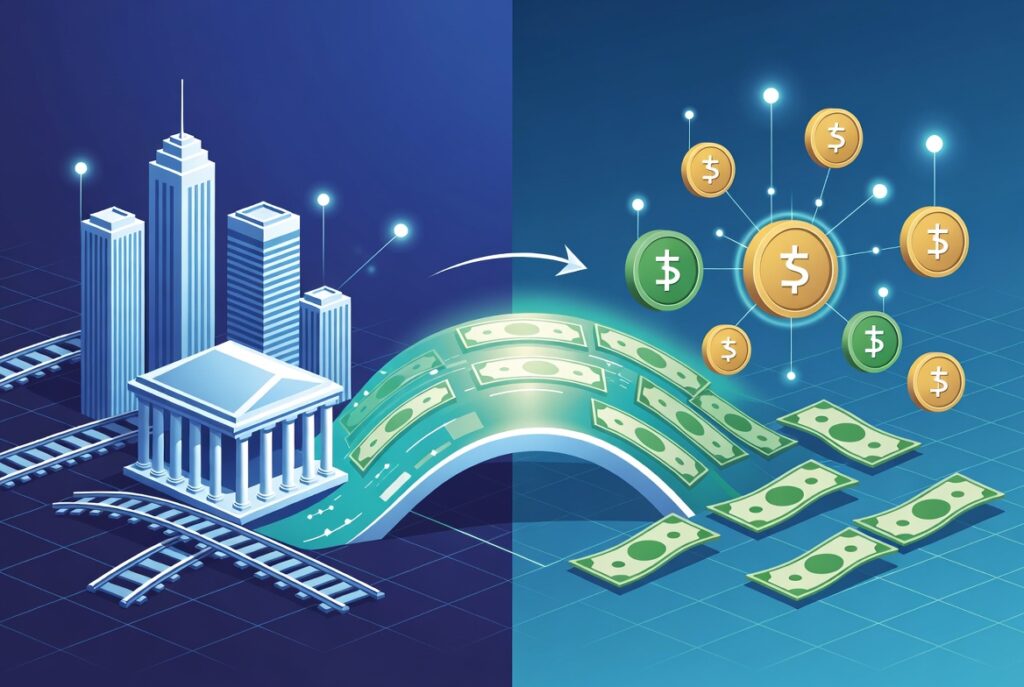
Tokenized Deposit Network: Why Major U.S. Banks Are Building One in 2027
The announcement that major U.S. banks are developing a tokenized deposit network represents a meaningful shift in how traditional finance is approaching blockchain technology. JPMorgan Chase, Citigroup, Bank of America, Wells Fargo, and other institutions are working through The Clearing House to build a system for on-chain clearing and settlement of bank deposits, with a target launch in the first half of 2027. Bank of America Joins Tokenized Deposit Network
What a Tokenized Deposit Network Actually Is
Rather than creating new digital dollars like stablecoin issuers, participating banks would represent existing customer deposits on blockchain infrastructure. This allows bank money to move more efficiently between institutions while remaining fully inside the regulated banking system. The aim is to deliver faster settlement, 24/7 availability, and programmable payment features without altering the fundamental nature of bank deposits.
Why Banks Are Adopting These Features
Stablecoins have shown that value can move quickly and continuously, unbound by traditional banking hours or legacy settlement systems. Their adoption by businesses and individuals has raised concerns about potential deposit migration away from banks. Many argue that blockchain technology could eventually replace core banking functions. Major banks are now responding by building similar capabilities into regulated infrastructure, partly to prevent potential deposit outflows to stablecoins.
Domestic Payments vs. Global Settlement
The two technologies are likely to serve different primary purposes.The tokenized deposit network is focused primarily on improving efficiency within the U.S. banking system. It aims to modernize how regulated banks move money among themselves while preserving existing credit and regulatory frameworks. In this sense, it is largely a domestic payments modernization project.Stablecoins, on the other hand, have already established themselves as a global settlement layer. They enable fast transactions between parties in different countries and financial systems without requiring everyone to operate inside the same banking network. This advantage is particularly relevant in cross-border commerce, where traditional systems remain slow and fragmented.
The Latin America Perspective
This distinction is especially clear in Latin America. Domestic systems like Brazil’s PIX have significantly improved local payment efficiency. Other countries in the region are also upgrading their internal payment infrastructure. However, cross-border transfers remain complex due to differing banking systems, regulations, and settlement processes.In this environment, stablecoins have become a practical bridge between separate financial systems. Many businesses involved in international trade use them to move value quickly across borders, often complementing — rather than replacing — local payment rails.
Validation, Not Competition
For these reasons, the tokenized deposit network should be viewed more as validation than as direct competition. The largest U.S. banks are investing in blockchain-based settlement because they recognize the value of faster, always-on, and programmable money movement. This development signals that the conversation has moved beyond whether blockchain belongs in finance to how it will be implemented.
Coexistence Is the Likely Outcome
The most probable scenario is coexistence rather than replacement. Tokenized deposits are well positioned to serve domestic institutional and corporate payments within regulated systems. Stablecoins are likely to retain a strong role in cross-border and multi-jurisdictional transactions, where interoperability across different financial systems is essential.
Final Thoughts
In the end, the bigger story is not that banks are competing with crypto. It is that blockchain technology is becoming part of mainstream financial infrastructure. Traditional banks and crypto-native systems operate under different rules and often serve different markets, but both are moving toward the same goal: faster, programmable, and always-available money movement. The tokenized deposit network shows how traditional finance is adapting, while stablecoins continue to demonstrate their strength as a global connective layer.